I usually talk about how unique we all are (in reference to tailoring our yoga practice to suit ourselves) and although that is true, no man/woman/human is an island!
Separateness appeals to our ego and is often sold to us as an ideology to encourage consumption. We are individuals and we all like to express ourselves differently and feel unique, we all have our own unique gifts to bestow upon and within the world, and this a wonderful thing, however sometimes our ego forgets the connection between us.
We are all experiencing the universe, granted different aspects of it, but the same universe. Different aspects will be less or more important to us given our perception preference at that time (e.g. – your friend mentions the amount of red cars on the road and suddenly you’re seeing red cars everywhere!). Then further to this, we all have our own interpretation of that perception, and following reaction to that interpretation. But the initial input, the universe, is as it is.
Obviously we can have vastly different experiences in life…. but we all feel and have felt those same pangs of anxiety in the middle of the night when you’re unable to sleep, rejection in its various forms, anger when we feel violated, and perhaps depression or dejection?
But also joy, happiness, peace and love.
We are all human beings.
We are all experiencing the universe as conscious beings.
So you can choose to repeat as usual, honking at Dave as he cuts you up on your morning commute and ruining your day, or pretending you’re unavailable when you see the phone ringing and can’t be arsed talking to x,y,z, or maybe flicking the Vs at your partner’s back as they walk away from an argument…
Or you could choose to pause, breathe and realise we are all connected.
You could smile at Dave, it may be the only one he’s seen in a while, he may be struggling at home or in life. You might choose to answer that phone call and be there for the caller, giving them the space and love they need by listening. Or you might choose to hug your partner and realise the argument you just had won’t even matter a few minutes/hours/days/years from now.
You could choose connection.
It’s too easy to play spot the difference. Why not train your brain to seek out and find connection with every being?
Empathy is another of those more subtle skills that yoga enhances. Perhaps you don’t need to improve in this area but I know I certainly did when I came to yoga (not that I knew it or would have admitted it then) and although my skills of empathy have and continue to increase, it’s still an area I need to work on. Here’s what I’ve discovered about empathy:
Empathy is HARD!
To let go of the ego and our ever present need to be ‘right’ can seem alien. To drop your judgments and open your mind to opposing ideologies is often extremely difficult. To understand others can be mind boggling. To allow yourself to feel all the pain, sorrow, anger and fear of another can hurt.
It takes vulnerability, and I hated to think of myself as even the teensiest bit vulnerable.
But I am. That was my ego I was hiding behind (and still do on many occasions).
We are all vulnerable. Whether we acknowledge that or not.
It also takes courage. To exhibit these skills when they can be wrongly perceived as a weakness takes guts.
So here’s what else I’ve learnt about empathy.
It’s BEAUTIFUL.
It allows you to expand your perspectives massively, increasing open mindedness and willingness to learn. You become less judgmental, and more mindful of your own behaviors and begin to see patterns in others, in nature and in life, attuning yourself to these.
And you increase your connection to others.
Your relationships become more meaningful.
Your vulnerability becomes your strength.
I am grateful every day for the empathy role models in my life; my daughter, and the one she naturally gets it from, her dad.
Everyone seems to have an opinion on yoga but what actually is it?
Have you ever tried to define it?
The more I learn, study and practice yoga the less I feel able to answer this question! Is it an exercise? Is it breath control? Perhaps it’s best described as a moving meditation or by others, just a mindful practice? Is it a spiritual practice? Is it a philosophy? Is it chilled or is it hard? Is it physical or mental? An ancient tradition or relatively modern?
The questions could go on forever and the answers would continuously differ depending on who, where and what you directed your question toward.
The yoga we know in the west tends to be the asana segment of Patanjali’s 8 limbed ashtanga yoga. There are many styles of yoga (focusing on the asanas), both fast and slow and everything in between, and although the asana side of yoga is rooted in Indian yogic tradition, there has been an intermingling of gymnastic poses on it’s journey to the west.
Within this form of yoga we may see the more ‘exercise’ style yoga classes, concentrating more on the physical benefits and gains of the practice. I have absolutely nothing against this and indeed, is how most people, including myself, initially engage with yoga. Yogis traditionally did have very strong and supple bodies as they were traditionally warriors and there is no doubting the physical benefits a regular yoga practice brings.
However, there are 7 other (somewhat lesser known) limbs to this practice:
Yama – External disciplines
Niyama – Internal disciplines
The yamas and niyamas kind of combine to create an ethical guidance for yogis. As an area of yogic philosophy, the yamas and niyamas are open to a variety of interpretations, all of which are thought-provoking to say the least (but this would be a whole other post, and may well be in the future).
Pratyahara – this refers to sense withdrawal. I interpret this not to mean an ignorance of the senses but an all encompassing focus which enables the practitioner to be completely present and undisturbed by sensory input (for example remaining immersed in something, be it a yoga session, creating art or even washing up, and undistracted by your phone ringing).
Dharana – focused concentration. Working in tandem with pratyahara, as without sense withdrawal (pratyahara) there would be no focused concentration, and vice-versa.
Dhyana – meditation, again interlinking with focused concentration (dharana) and sense withdrawal (pratyahara) to enable complete absorption into a meditative state.
Samadhi – this refers to enlightenment, although enlightenment itself has been described in various ways. I am not an enlightened being myself so I can not tell you what it is, however, others have described it as being in a state of bliss, or becoming so immersed in meditation that the practitioner becomes one with the meditation object. I personally prefer the description given by Ram Jain, of enlightenment as ‘freedom from illusion’. This may initially sound much more easily attainable but when you consider the conditioning of our brains, the narratives we consistently employ surrounding our own and others experiences, the subjectiveness that we view all events through, ‘freedom from illusion’ becomes a worthy but extremely arduous (if not impossible!) goal.
So, in answer to the original question, what is yoga? Yoga is all of the things we posited earlier and then some. The great thing about yoga? It will meet you wherever you are at and provide whatever you are looking for (be that exercise, philosophy, self development etc) but be prepared for it to give you so much more when you are ready to receive it.
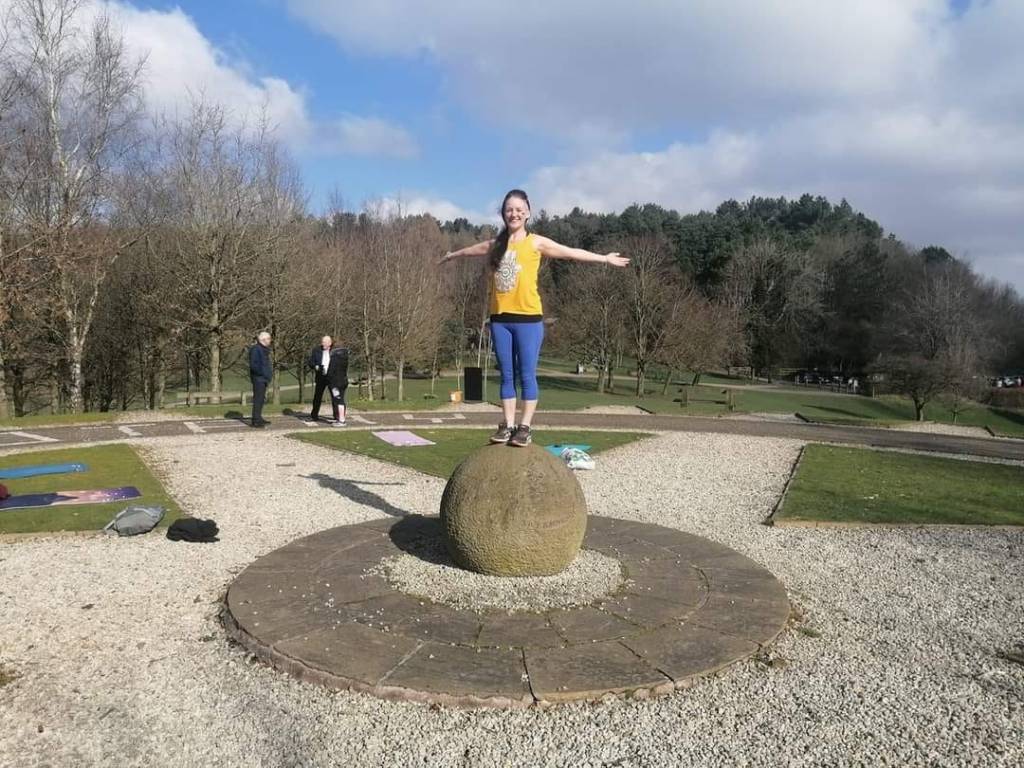
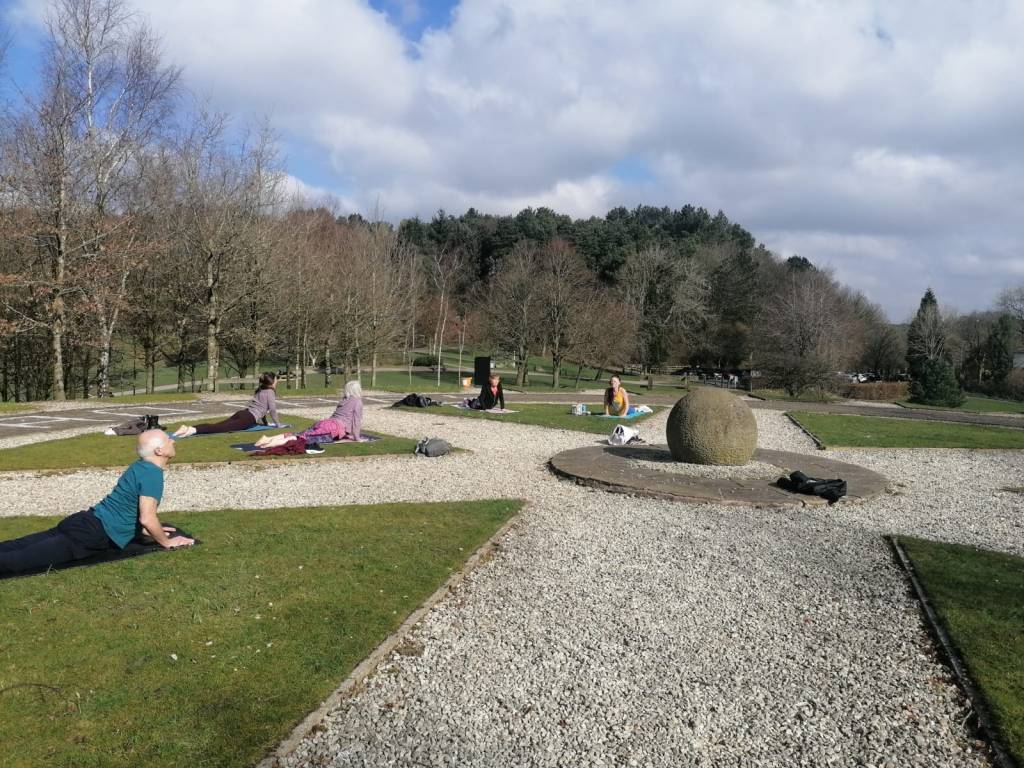
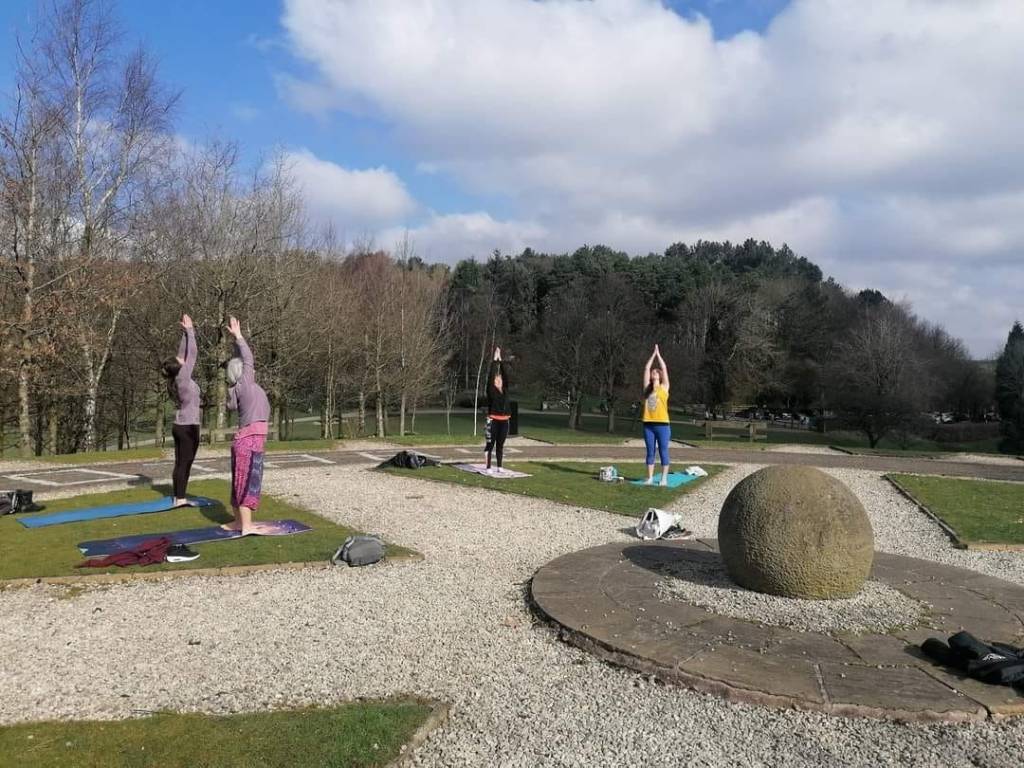
This Spring equinox, the 20th March 2022, myself and some fantastic yogis joined together in Tandle Hill, Royton, Oldham, Greater Manchester in order to do what we could to raise funds to help towards the humanitarian crisis in Ukraine.
When I saw the events unfurling in Ukraine, I really felt for those innocents, suffering at the hands of others. Although we can meditate on peace, I wanted to actually DO something but I felt powerless; I couldn’t provide medical care as I’m not qualified, and I can’t provide a huge amount of financial aid on my own.
However, it is my true belief that everyone has some talent or skill that can be used to help others. It just takes some creative thought to find a way to do this.
Something I can do is yoga, and a lot of other people enjoy yoga too. I’ve always enjoyed a challenge, so it occurred to me that I could set up a fundraiser, encompassing a yoga challenge for myself and anyone who wished to join me, in order to raise financial support to help those suffering in Ukraine. So I set up a JustGiving page, advertised it at all of my classes and social media platforms and even got in the local paper.
The challenge was a ‘Yoga-thon’, which involved 108 Sun Salutations, aka a ‘yogamala’. A sun salutation is a series of poses put together in a flow and why 108? Well, it’s an auspicious number in Indian and Yogic tradition for various reasons (such 108 marma points in the body, 108 upanishads, 108 tantras, and these are just a few of the reasons), and we kept count using crystals.
Luckily the weather was perfect, the company fantastic and the support outstanding. People were free to join for as few or as many as they liked. Many who took part were amazed by their own performances and we thoroughly enjoyed the experience (though my hamstrings are feeling it now!).
All donations have been gratefully received. My JustGiving page will remain open until Saturday 28th March 2022 so please feel free to donate if you can via the link below.
In the field of psychology a persons belief in their degree of control is known as their ‘locus of control’. Whether an individual believes they can control events internally or events are controlled externally has been thought to be based upon child hood experiences and personality traits.
However, I do not believe the situation is so clear cut.
Control is something that many of us like to have, strive to have even, though it is often completely illusory.
As events of the past 2 years or so have taught us, we have little to no control over so many things. We didn’t choose to experience a world wide pandemic. We don’t choose to fall ill, or get older. We don’t choose so many of the events that happen in our lives. We don’t even choose our thoughts. We don’t choose our genetic makeup, we didn’t choose our environment as children or adolescents. Indeed, aren’t we arguably all just a product of our experiences that are formed from our environment impacting upon our genetic makeup?
And yet so many of us spend so much time “What if-ing”, trying to gauge every possible outcome to a situation (with myriad variables) so that we can be prepared for it and control it.
But we can’t control it.
We can’t control other people, nor their reactions or perceptions of things or ourselves. That will depend upon their subconscious, past experiences and conscious reactions. Hence why different people can give so many different opinions of the same events. We can’t control world events, mass pandemics, rises in energy bills etc etc. The list goes on and on.
But what we CAN control is the breath.
And through control of the breath we can find a deeper awareness and control of our reactions to things.
HERE LIES OUR POWER
Here we can have our control.
Control in our choice of how to act/react in and to any given situation.
And for that, we are responsible.
Do make plans, do have goals. Do realise that these may be impacted by forces beyond your control. Do breathe. Do choose your actions from a place of calm and do respond accordingly.
Apply a healthy balance of internal and external control.
Ps – Try not to judge yourself if you do find yourself “what if-ing”, just acknowledge your concern without judgment and remind yourself of what is within and outside of your control.
Do you find yourself wanting to be somewhere/do something/achieve something etc but there’s just always something, some obstacle that gets in your way and prevents it?
The single most common obstacle is yourself (and I am not in any way judging here, I know because I do the same, neither am I trying to belittle anyone’s circumstances).
The self.
The ego.
We make excuses to keep us ‘safe’, to maintain the status quo, protect the ego and dissolve our liability.
Maybe this isn’t the case for you. Maybe you don’t do that and if so I congratulate you. And granted, there are things that are out of our control (as COVID has just proved!). But generally speaking ( i.e – improvements we strive for in health, changes in behavioural habits etc) this is not true for most of us.
So think about it for a minute.
I mean, REALLY think about it.
Are you your own biggest obstacle? Or do you recognise that you create (at least some of) your own obstacles?
Once you become aware of it you have taken your first step to changing it. You can then take further steps towards overcoming the obstacle. It won’t just disappear though, none of us have magic wands or magic pills.
There are NO quick fixes...
But we can commence and enjoy the journey together. It will take time and effort, but the freedom from self imposed and self limiting obstacles offers endless possibilities. X
Children all over the UK have returned to school recently, some very happily but many others have struggled. We are all unique as are our experiences of the same event, and our feelings, as evidenced in the recent survey reported on by the BBC: https://www.bbc.co.uk/news/extra/nfpahaz8or/newsround-survey
Here are some top tips for children who are struggling since returning to school:
Re-evaluate expectations
Neither you, your teacher, nor your child should expect them to just return to ‘normal’. They have had months of learning from home, with different expectations and rules – allow them to adapt gradually to the new situation.
Discuss feelings
Allow your child/children safe space and time to talk about their feelings, let them know theses are normal and natural. Help them to identify them. Then come up together with strategies to deal with any difficult emotions they may be experiencing – they and you know your child best and what will work for them. Obviously I am a great advocate of yoga and the huge benefits this brings have been widely documented, though you may also want to try breathing, doing something creative or whatever works for them.
Give them choices
Just think about the freedoms working from home allows. Your child has been experiencing these freedoms for some time and now all of a sudden, all these freedoms have been taken away as they return to school, they can’t choose what to wear and even have to ask to go to the toilet. They have had lots of choices curtailed so try as much as possible to allow them to exercise some control through their choices (where appropriate).
Have fun!
By which I mean smile, play and laugh with your child. Again, you know your child best so maybe let them choose an activity and spend time having fun together. This will be one of the best stress-busters out there.
Get yourself signed up to my newsletters which will be giving away free taster guided meditations for kids and watch this space for downloadable feelings sheets for kids coming soon.
This Eating Disorders Awareness Week I got the amazing opportunity to interview published author Anupa Ropa to ask her about body image and her new book, ‘Sparrowlegs’.
Anupa Ropa, Author of ‘Sparrowlegs’
Anupa Roper lives in Leicestershire with her husband and 2 children (Maya, 11 and Ayden,10). She allowed her label of ‘skinny’ to affect her choices and her feeling of worth for a long time. Now she wants to empower the young by helping them to feel happy in their own skin. She would love for the generations that follow to know that they are worthy just the way they are. Follow her journey @miss_sparrowlegs on Instagram.
Anupa has also published her debut book ‘Sparrowlegs’ about a sparrow who learns to love the feathers she is in and realises how amazing her body is. This book is aimed at 3- to 7-year-olds and available on Amazon.
Body image is what children think and how they feel about their body. It includes the picture in their mind that they have of their body and this may or may not match their body’s actual shape and size. In children’s minds, there will be aspects of their body that they like and some that they dislike.
Children as young as 4 can have body image issues and it can affect both boys and girls.
Why is having a positive body image important?
When children have a positive and healthy body image, they feel happy with their bodies. They accept the way that they look, and they feel comfortable in their own skin. The problem with children having a negative or unhealthy body image is that they can feel unhappy with their body. Children may think that the shape, size, or appearance of their body needs to change.
It is important for children to have a healthy body image. When they feel good about their body, they are more likely to have better self-esteem (which means the opinion that they have of themselves) and mental health (which is the way that they feel in their minds) Children will also be more balanced in their attitude towards eating and physical activity.
What can affect body image?
Children’s body image can be affected by numerous things including:
Parents and carers (who can play a critical role). How we talk about our own bodies, the comments we make about our children’s or other bodies can all help to form our children’s thoughts, feelings, and opinions. It can also be our body language (frowning when we look in the mirror etc)
The attitudes of their friends and peers. How important appearance is to them. How they talk about bodies. Children will often be influenced by those directly around them.
Media. It is difficult to escape the ‘perfect body’ ideals promoted on the television, in magazines, on the internet and on social media.
How can we support our children to have a better body image?
Talk about your body nicely. Use positive language. It’s okay if we struggle ourselves with body image if we remain neutral when we talk about our bodies.
Focus on what yours and your children’s bodies can DO. Show them that bodies are so much more than what we look like on the outside. Your body is there for you when you hug someone, when you talk, when you eat. We must be grateful for the amazing things that our body can do.
Encourage your children to eat healthy foods but to know that it is okay to also eat the foods we should have less often. Help them to understand that eating nourishing food not only gives you the energy you need but it makes you feel good inside.
Encourage your children to be active. Your body needs to move to be strong, fit, and healthy. Pick activities they will like. Enjoy the fun you can have together. Yoga is perfect!
If your children are older make sure you are aware of what they are viewing through their social media. Encourage them to follow accounts that make them feel good (that goes for us too!)
How should I talk to my child about body image?
If you hear your child make comments about their body, talk to them about it and ask questions. That will start conversations around body image, where their opinion comes from and overcoming it. Also, when watching television or reading books discuss what you see (relative to age). My book for age 3 to 7 is a great way to kick start conversation.
Finally, let’s remind our children that they are all beautiful, they are all worthy, they are all more than enough – just the way they are.
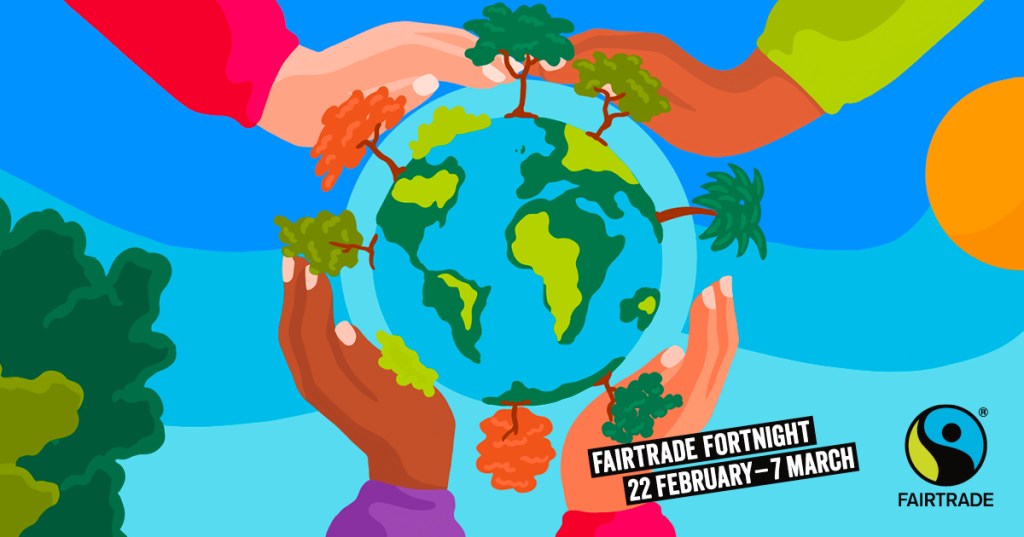
I consider myself to be quite a thoughtful and considerate person. However, this Fairtrade Fortnight has really got me thinking about my shopping habits, Fairtrade products and my wider impact on the world.
Fairtrade has been around a long time now, since 1992. That’s nearly 30 years of making a difference to people’s lives and livelihood through campaigns and spreading awareness throughout the western world, of the harsh realities of working life for people and communities at the start of our chocolate/coffee/clothes’ (etc) life, and trying to better these.
So Fairtrade should be huge by now right? Well, in some respects, it is. There are now over 4,500 licensed and certified Fairtrade products for sale in the UK (as noted on the Fairtrade website at 24/2/21).
These are commendable behaviours from large retailers. However, searching via many UK supermarkets online shopping systems, my expectations for choice of Fairtrade products are not nearly met. In fact one result showed just 6 Fairtrade items available.
So is Fairtrade in the mainstream or not? Is the lack of Fairtrade choice a reflection of the current times where many UK citizens have lost their jobs or been furloughed or otherwise struggling at the moment? Or transportation issues due to covid?
Fairtrade is relatively more expensive, but necessarily so in order to ensure a ‘fair trade’ is done at the start of the products life, thereby ensuring that farmers and workers growing and harvesting crops are given a ‘fair’ deal for the work they do so that they can ensure decent living and working conditions for themselves and their community.
This should be something that matters to all of us and I would urge those in a position to purchase said items to do so. However, that said there are other things we can all do to help the plight of farmers and workers from countries closer to the equator. You see, it is not only the trade price and working conditions that affect these farmers and workers, but also climate change is having a huge impact on their crops these days. Farmers are seeing an increase in floods, droughts, violent storms and diseased plants. The resolution to this is something we can all be part of. Cutting down on plastics, reusing and recycling, growing organically are all things we can take on board and have a positive impact on.
The onus and the opportunity is ours, to choose the world we want.
“Good nutrition is eating a balanced intake of macronutrients (protein, carbohydrate and fat), vitamins and minerals to meet the body’s energy requirements and support healthy growth and development, both physical and mental.”
How does diet affect children?
“I’m sure we’ve all seen the after effects of a kid’s party! Diet is hugely important in the behaviour and development of children. Poor diet can lead to vitamin insufficiencies such as vitamin D which can affect bone growth, and it has even been shown that a lack of iron may be linked with ADHD behaviour in children. Conversely, giving children too much sugar can lead to blood glucose peaks and troughs which can result in an overtired, over-emotional child. And too much fat by way of chips, crisps, fried foods etc can lead to childhood obesity – a problem which is now prevalent here in the UK.”
What is a balanced meal?
“Try to remember the 3 macronutrients and build your child’s plate from there! Protein is essential for a growing child as it is the building block for new muscle, tissue and organs in the body. This can be meat, fish, yoghurt, nuts & nut butter, beans and lentils.
Carbohydrate is broken down into glucose in the body and is the preferred source of fuel by the brain. White carbs can break down rapidly though, resulting in blood sugar peaks then troughs, and possibly the reason your child never seems full! Swap out refined, white carbs such as white bread, white pasta, white rice, (which have very little nutrient content), for their healthier complex counterparts – wholemeal bread, lentil pasta, brown rice, oats, vegetables. This will ensure a steady stream of energy, and on top, they provide valuable nutrients such as B vitamins and beta glucans which support immunity.
Fat – just as we need healthy fats, so do our children. Omega 3 fats from fish for instance can support our immune system and contribute to brain health. Aim to have 2/3 portions of oily fish per week. These can be salmon or fresh tuna for example – making them into fishcakes is a good way to make it more appealing to little ones. Incorporating coconut oil and nut butter into porridge is a good way of getting good fats into kids easily.
By giving your child all 3 of these at every meal, this should provide adequate and steady energy throughout the day, as well as stabilize their mood and mental performance.”
How much should my child be eating?
“As a general guide, the palm of your child’s hand indicates a portion of veg, of fruit etc… But my advice would be, your child knows what it needs and will eat accordingly. They will generally dictate, and overeating is only really an issue if they’re eating the wrong stuff. Another reason to get healthy habits in order. If your child seems to always be hungry, check the above – are they getting protein, complex carbohydrate and fat with every meal? Chances are their meal didn’t sustain their energy requirements.”
What if my child won’t eat ‘healthy’ food?
“Picky eaters can be hugely distressing for everybody, but they are programmed to survive and will not starve! Try not to use this as a reason to ply your child with ‘treats’ such as pudding or sugary cereals etc, as all this does is show them that these will always be offered. Instead, persist with offering the the healthy plate you’d like them to eat, and if your child only tries a bit of it, then take this as a win. If this doesn’t work, start to smuggle food into their favourite dishes! Blend vegetables such as onion, carrot, broccoli, spinach into their favourite pasta sauce, or when making a shepherds pie, add a tin of chickpeas to the sauce and mash with a potato masher. They’ll never know, and you’ve just added protein and iron to their plate!
A child’s taste-buds change and develop and you’d be surprised what they start to like if it’s offered to them. But this is less likely to happen if all they are offered is junk.”
Do you have any top tips for parents?
“There are many easy snacks out there for kids to graze on – don’t assume just because it’s labelled ‘organic’ it’s healthy. These are convenience snacks and can often be laden with fat and/or sugar.”
“What’s your child drinking all day? Be mindful that cordials, and even smoothies and juices are sugar hits for children. And these soon add up throughout the day. Try to stick to water and reserve juice for a treat, or the weekend. Juice is metabolized quickly into glucose and gives the same sugar peak and trough as sweets, or even cola.”
“Set a time in the evening when eating stops, ideally dinner time. Eating late into the evening can severely disrupt sleep. It may not be as obvious as your child waking you in the middle of the night, but food from the night before can impact sleep cycles which can lead to a sleepy child and affect performance and concentration.”
“Try to avoid categorizing food. If we make a huge fuss about a child eating their vegetables for instance, this can cause a child to fixate negatively on it. Treat fruit and vegetables and other healthy foods as you would any other foods, without alienating them. Likewise, try healthy fun snacks such as carrot sticks or mangetout and hummus, grapes and cheese chunks, pear slices and peanut butter. A ‘treat’ can be whatever you decide it is – it doesn’t have to be sugary sweets or chocolate.”
“Try to encourage mindful eating; eating at regular times, together as a family, and avoiding eating in front of the TV are good habits to get into, and actively encourage a good relationship with food.”
“Try not to get too bogged down with it all! Much of a child’s eating habits is a phase and part of them exercising control and learning about their world. If you’re anxious around mealtimes, they will be too. Stay calm, make it fun, praise them when they try new flavours, and rest assured they’ll grow out of it. After all, you don’t see many adults existing on a diet of spaghetti hoops and cheese!”
A bit more about Laura:
Laura studied biomedicine and nutrition for 3 years, then started practising and helping clients feel their very best selves. She states “As a nutritionist, I dedicate time to get to know you and your lifestyle, to get to the root of your symptoms, and then support your body holistically, without just treating isolated symptoms. I believe in self-care, and prioritising health and wellness, before we are forced to make time for illness.”
You can follow Laura on her instagram page via the link below or find out more about her and her services through her website, listed below. http://www.lkghealth.com/laura-hardy










 Go To Yoga